
Modular headlamp concept with two charging-case configurations
OEM / ODM headlamp development example

Build the headlamp as a system.

This development example shows how MFOPTO can connect a wearable light, charging dock, protective case and accessories in one scalable architecture, then carry the selected direction into prototyping and production planning.

2 kit formatsDual headlamp or accessory kit4 connected partsLight, case, dock and accessories1 shared architectureAdaptable colors, packs and SKUs
Storage-type headlamp conceptWear / charge / protect / configure
Choose the right development depth

Invest where the market will notice.

A clear route aligns schedule, tooling, ownership and the amount of product change before engineering begins.

01 / PRIVATE LABEL

Launch a proven headlamp under your brand.

Product marking, color, packaging, manual and selected accessories.

Discuss a faster launch →
02 / PLATFORM ADAPTATION

Build a new kit around a proven module.

Headlamp functions, charging, wearing system, accessories and case layout are adapted to a defined market.

Review the adaptation scope →
The MFOPTO development narrative

Start with the job. Build the kit around it.

The opportunity is not simply another brighter headlamp. It is a ready-to-use kit that keeps the light charged, protected and organized between tasks.

Each chapter closes one decision before the project moves forward.
01
Opportunity definition

Find the use case before defining the kit.

Family backup, vehicle emergencies, two-person outdoor use, maintenance work and branded programs create different expectations for storage, charging and accessories.
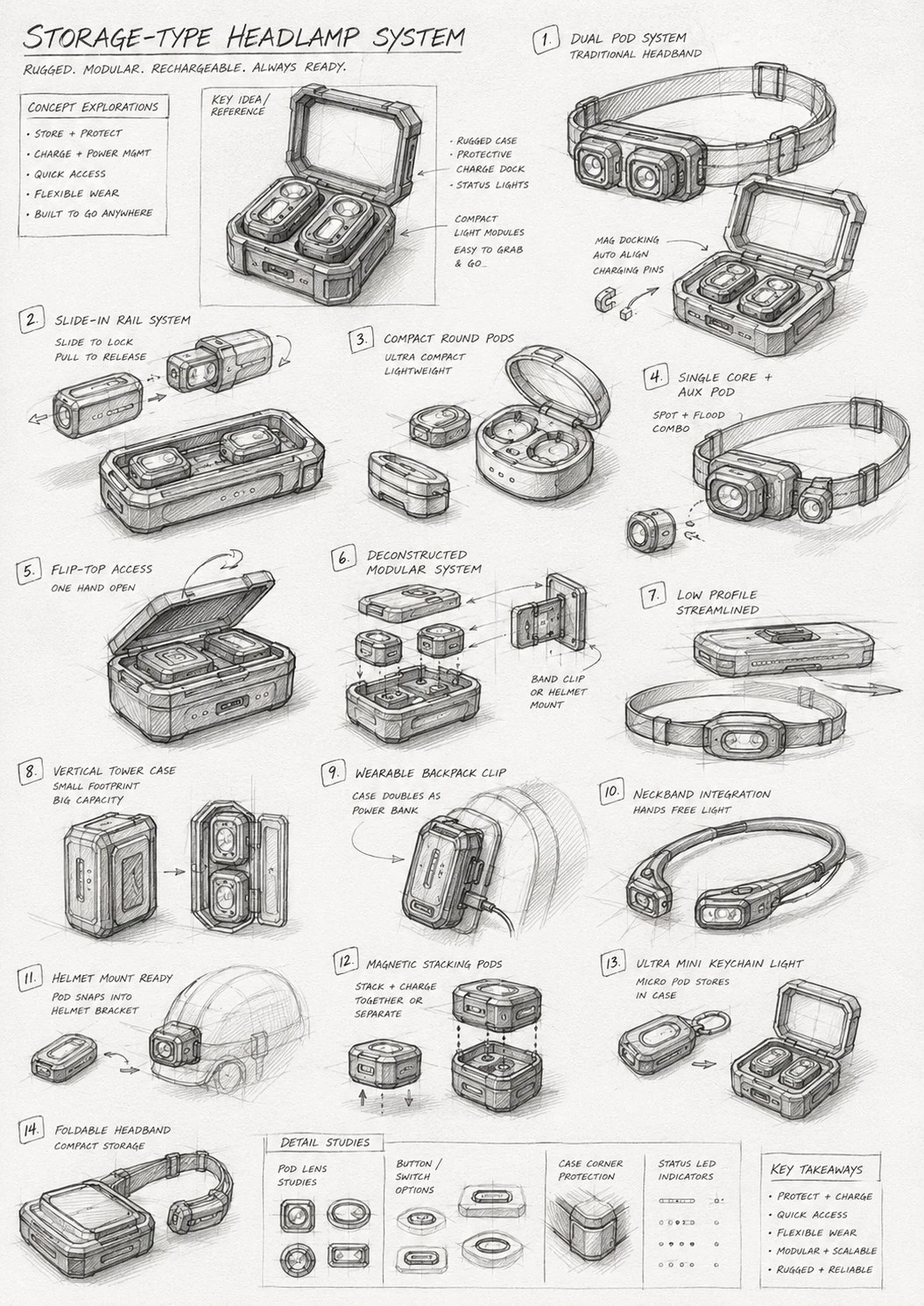
Early concept sketches for a modular headlamp and charging case
Concept exploration begins with how the light will be worn, stored, charged and carried.
User situationsEmergency, outdoor, maintenance and team use.
Design questionWhat must stay together and ready?
Decision outputUse-case and kit brief
02
Product architecture

Make the case part of the product.

The headlamp, charging dock, internal tray, accessory bay and protective shell are resolved as one reusable architecture.

CAD layouts for dual-headlamp and single-headlamp charging case configurations
Shared architecture: one case format supports two commercially distinct kit configurations.
Version ATwo headlamps for backup, partners or teams.
Version BOne headlamp with task-specific accessories.
Decision outputSelected kit architecture
03
Design and engineering

Balance optics, wear and charging.

The front optical layout, center of gravity, controls, strap interface, battery space and charging contacts are developed together.

Front CAD view of the modular headlamp optical layoutRear CAD view of the headlamp wearing and charging interface
Module definition: spot and flood optics share one wearable, chargeable architecture.
Design workFit, controls, quick access and visual identity.
Engineering workOptics, structure, battery and contacts.
Decision outputEngineering direction
04
Design review

Review the complete kit before prototyping.

The integrated concept helps the team assess case access, charging position, component retention and kit organization before committing to physical samples.

Integrated rendering of the modular headlamp charging case
Integrated rendering: the case, dock, headlamp and internal layout are reviewed before prototype construction.
Use reviewWear, operate, remove, store and recharge.
Prototype questionsFit, retention, contacts, hinge and latch.
Decision outputPrototype brief and review checklist
05
Industrialization path

Prepare approved designs for repeatable production.

After design approval, tooling, internal trays, colors and materials, pilot assembly, inspection references and packaging can be prepared for each released kit.

MFOPTO portable lighting assembly environment
MFOPTO production capability: released products move into defined assembly and inspection processes.
Shared controlsHeadlamp module, case and charging interface.
SKU controlsTray, accessories, colors and packaging.
Gate outputProduction-ready configuration
CAD architecture of modular headlamp charging-case layouts
Engineering is a connected system

One platform connects light, charging, storage and sales configuration.

The headlamp only works as a system when the wearing experience, optical modes, charging contacts, case structure and market kit are designed against the same brief.

01 / LIGHTSpot, flood and optical layout
02 / POWERBattery, USB-C and dock contacts
03 / WEARBalance, strap and adjustment
04 / CASEProtection, access and display
05 / CONFIGUREDual kit or accessory kit
06 / MARKETCMF, branding, pack and documents
Development concept: two kit formats

One charging case supports two market offers.

The shared architecture can address different users without redesigning the complete kit.

Storage-type modular headlamp concept

Reuse the core. Change the kit logic.

Version A carries two headlamps for family or vehicle backup, two-person outdoor use and team equipment. Version B combines one headlamp with accessories for maintenance work, personal outdoor gear, branded gifts and customized programs. Both retain the same charging logic and protective-case architecture.

01User situation02Shared module03Kit selection04Channel variant
Concept rendering of dual-headlamp and single-headlamp accessory case configurations
From prototype to production

Four gates separate a concept from a released product.

Each gate defines what must be demonstrated before the next investment or production commitment.

01 / FUNCTION

Does the complete kit solve the job?

Optical modes, wearing comfort, controls, removal, storage and charging.

Approval target: functional prototype
02 / TOOLING

Can every interface become stable parts?

Headlamp housing, case, lid, tray, dock contacts, materials and assembly fit.

Approval target: engineering sample
03 / PILOT

Can the kit be built and checked repeatedly?

Charging alignment, hinge and latch cycles, retention, endurance and pack-out.

Approval target: pilot build
04 / RELEASE

Is each configuration fully defined?

Product specification, BOM, colors and materials, inspection references, labels and packaging.

Approval target: production release
Commercial clarity

Define the project rules before development becomes expensive.

Terms depend on development depth, tooling scope, destination market and commercial assumptions.

Economics

MOQ, samples and tooling

Development charges, mold investment, payment stages and volume assumptions.

Ownership

Design, mold and exclusivity

Ownership of tooling and design files, plus any market or time-limited exclusivity.

Change control

Approvals and schedule

Revision rounds, decision owners and the schedule effect of customer changes.

Confidentiality

NDA and project access

Customer materials, internal access and permission to publish project content.

Compliance

Final configuration

Testing and documentation must correspond to the final product and destination market.

After launch

Warranty and change management

Issue handling, replacement parts, repeat orders and controlled product changes.

Start with a useful brief

Bring the headlamp use case. We will define the system.

The first review focuses on who wears it, where it is stored, how it is charged and which kit configuration creates the strongest market offer.

User and application
Dual kit or accessory kit
Optical modes and runtime
Target price and quantity
CMF, branding and packaging
Launch market and date